
Updated Feb. 2026:
This is the main website for the Conifer Pyrometrics modelling system (CP, also called Canadian Conifer Pyrometrics or ConPyro). ConPyro is an empirically-based fire behaviour prediction system based on Canadian experimental fire and wildfire data. At present, ConPyro predicts wildfire equilibrium rate of spread (ROS) and type of fire (surface, passive crown, or active crown fire) for variable fuel structure conifer forests on flat ground in a one-dimensional, stand-level framework. Related methods from the Canadian Fire Behavior Prediction (FBP) System can also be used to predict fuel consumption and fire intensity. ROS outputs are in m/min, while surface fuel consumption (SFC, an input for ConPyro that can be estimated) is in kg/m2, as per FBP System convention.
While methods for incorporating variable slope and fire acceleration have been developed, they have not been published yet. Novel methods for estimating ladder fuel influence to crown fire initiation have also been developed and are available in draft form. There is an R package that will be released soon, as well as exciting developments in progress to incorporate ConPyro into a full-fledged fire growth model, (spoiler alert: PyroCell), along with ensemble modelling linkages for a wide variety of simulations.
Until a more comprehensive guide becomes available, this page houses the latest official ‘production’ software and reference documents for users.
FuelDash (online or Desktop) is a dashboard and calculator that has a been an important ConPyro conceptual tool from day one (see Perrakis et al. 2020, linked below) and is also a great introduction and training tool for ConPyro . It was developed based on FuelGraph, a similar tool for the FBP System.
On its own, FuelDash is a graphing tool that shows fire type and equilibrium ROS and allows for a quick visual representation of what happens to fire behaviour when fuel structure or weather inputs (raw weather or indices) change. This makes it idea for developing hazard reduction fuel treatments, as the different inputs can be adjusted manually to show immediately how ROS and fire type change. It also contains some related calculators, which produce quantitative outputs that can be easier to report than the graph results. As this is a rich field for new research findings and developments, there remains much room for progress, but I’m proud of how easily and readily FuelDash shows some of the nuances of fuel treatment design.
FuelDash – online: Shiny app
FuelDash – desktop: Excel
There’s also an Excel-based tool for calculating the stand-adjusted litter moisture content (Wotton and Beverly 2007), one of the important ConPyro intermediate outputs.
(Note – these are the ConPyro applications, not to be confused with the FBP-based FuelGraph app.)
If you haven’t looked at FuelDash (formerly FuelGraph-CP) in a couple of years, you will note a much cleaner user interface than in older versions, as well as some additional tools and capabilities. Newish additions include a precise probability of CFI calculator, stand-adjusted mc estimator, and options for using Cruz and Alexander’s ‘10% rule’ (actually 8.4% for conifer forests) when active crown fire is predicted. The surface fire models also have a few new choices. Finally, the ‘smooth CFI’ option presents a smooth ROS transition between surface fire and crown fire, based on the probability of crowning function (calculated based on the equations from the 2023 paper).
Beyond FuelDash, there is a growing body of formal documentation on ConPyro, though this is still a work in progress.
Current reference documents are as follows.
1. Conference paper describing the overall CP scheme:
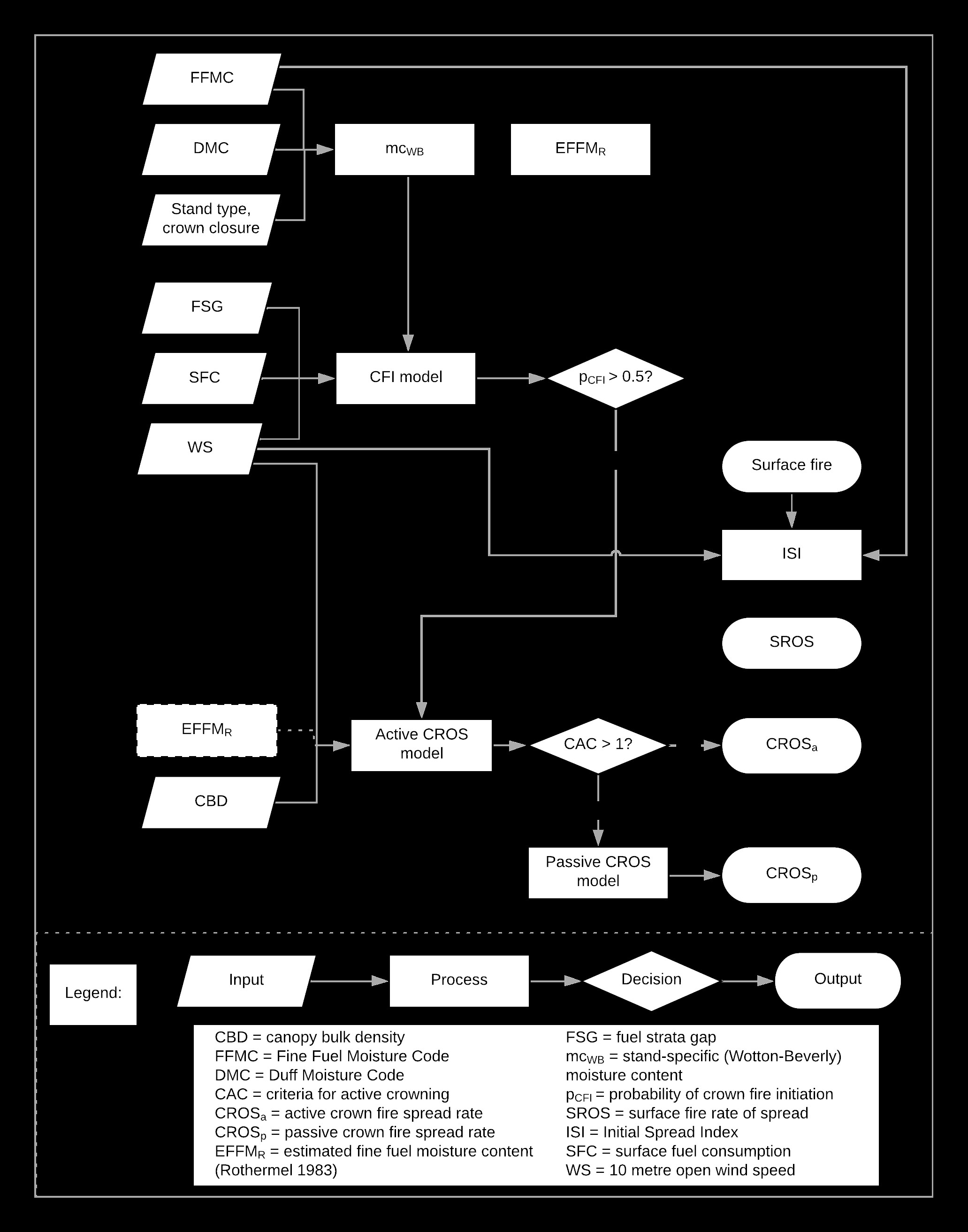
2. Updated empirical crown fire model paper, published in IJWF, with extensive appendices and online supplemental material:
See also the Supplemental Material.
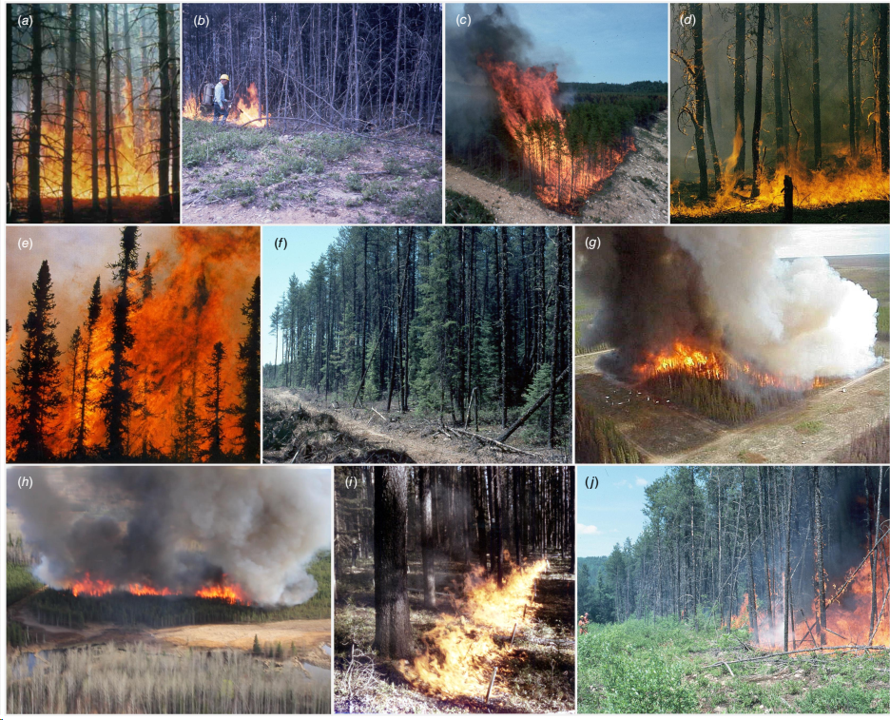
3. Ladder fuel theory conference paper. This short paper (extended abstract) was presented at the 2024 Fire Behaviour and Fuels conference in Boise, ID, USA, and has been accepted for publication in the forthcoming Proceedings document.
4. Working paper (2022) describing the crown fire reanalysis and linkages with other associated models. This document is largely obsolete following the publication of the 2023 IJWF paper (above), but is a good report for seeing some as-yet unpublished elements such as early versions of the surface fire models (in Appendix B). Note that it describes a ‘training vs testing dataset’ approach that was abandoned for the final crown fire occurrence modelling, but remains interesting.
In addition to these tools and documents, there are several other papers currently in the works using these models in field and case study applications that should help with real world credibility. Together with collaborators from Monash University, Australia, some related machine learning models were also developed from the surface and crown fire data; we may try to incorporate these into the CP calculators if possible. There is also a GIS tool and spatial fire growth model in the works, both exciting developments led by some collaborators that provide workable solutions to some persistent questions and gaps. So stay tuned!
As described elsewhere on this blog, this all started as a quest to develop a simple FuelGraph-like tool for the CFIS system. Once a need for data reanalysis became apparent, it became a bona fide research project and system in its own right. The conference paper, working paper, updated crown fire model, and ladder fuel and surface fire models (last two both TBC) followed. At present, it represents a vision for a mostly-empirically based conifer fire behaviour prediction system that uses continuous forest structure variables and avoids the need for subjective fuel type decisions. It may be overshadowed within a few years by the ‘Next Generation’ FBP System (see the NG-CFFDRS vision document), but will likely be supported as a legitimate system in its own right for many years to come.
At this time, I suspect that the largest potential source of error (and uncertainty) in ConPyro is in the crown fire rate of spread (cROS) implementation. In CP, cROS predictions result from a simple empirical calibration between Rothermel’s EFFM (required to calculate the Cruz et al. 2005 cROS models) and estimated litter moisture (from the mcSA or FFMC) using some data from lodgepole pine stands in BC. There is also the option (under ‘Advanced Settings’) to use Cruz and Alexander’s ‘10% rule’ model for Active cROS, as noted above, and this is a nice option to use for comparison purposes when in doubt.
For those interested in the code, I am gradually getting everything on GitHub, as noted here, but it’s all still a bit messy.
Finally, it has been a slow process to get the ‘final’ models published, even while most of the vision has been in place for more than 5 years at this point. I appreciate everyone’s patience. Clearly, it is a bit risky to propose and teach methods that have not yet been sanctioned by the research community via peer-review. And yet the need exists for these tools – for designing fuel hazard reduction treatments, for estimating fire behaviour in a manner that goes beyond the basic FBP fuel types, and for incorporating more recent fire behaviour research findings and concepts into operational decisions. I don’t believe that any big errors have emerged in the past 5 years regarding these models, but we’re always looking for opportunities for improvement. Please contact me if you have suggestions, find bugs or have other comments.
-DP
 FireResearch.ca