
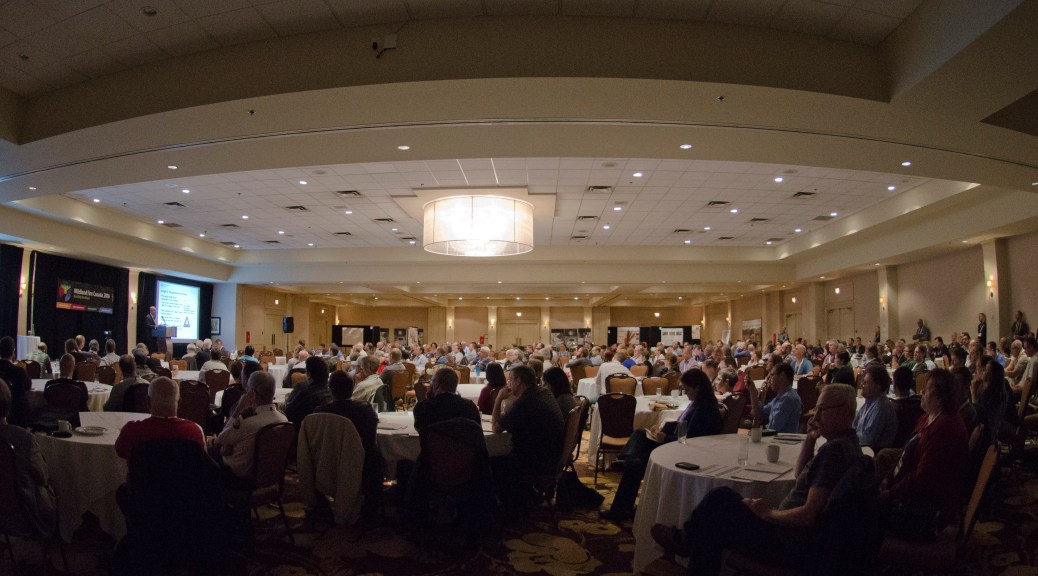
I just returned from a conference (IAWF 18th Wildfire Safety Summit / 7th Human Dimensions Conference, Calgary, 2025), and had a great time! Kudos to Mikel and the other staff from the IJWF who worked hard and put on an excellent event. As before, I met with old friends and colleagues, met some new ones, and it got me thinking about wildland fire conferences and workshops in general. Most acutely, I’m recalling all the work, successes and challenges associated with being co-chair of the 2016 Wildland Fire Canada conference (WFC2016: Building Resilience, Kelowna, BC). I’m also hoping my memories of this conference don’t fade too quickly. I’m just a bit sad that I didn’t see much evidence of video recording (phones, cameras, whatever) of the various presentations and don’t trust my notes to be much help; but more on that later.
After WFC2016, it took 3 years (instead of the customary 2) to get the next WFC conference held (WFC 2019: Ottawa, ON), and that was the last one that was co-hosted by agencies and the CFS. Ever since 2022 (Edmonton, AB, the Covid-era conference), the event planning has been handled by the International Associated of Wildland Fire. As for the program, venue hosting and theme, the details are murky to me, but it appears that the CFS has largely taken these over (don’t quote me on this).
What happened in the lead up to 2016 in Kelowna? Predictably, it was a tonne of work, as my co-chair Kendrick Brown and I travelled around the BC interior visiting hotels, conference facilities, field trip venues, and wineries (that part wasn’t bad) to put it all together. A separate committee was building the technical program, and we worked together to invite gues speakers and solicit workshops. We debated room layouts, entertainment, A/V setup facilities, and schedules, and most of all – trying to guess how many people would pay the $500-$700 conference fee and actually show up. Neither Kendrick nor I had much experience in event planning, but we did get some good advice from industry professionals as well as – critically – an organization (CIFFC) willing to backstop the event with an initial loan and corporate guarantee. Like, if another 9/11 or Covid-19 type event happened a week before the conference and we had to cancel everything, the hotel and other businesses were going to want their pound of flesh. Someone had to be ready to take on the risk of booking hotel rooms and hiring guest presenters.
At the end of the day, of course, WFC2016 was a big success, the largest attendance of any Canadian wildfire conferences at the time, with the only hiccup being the rained out field trip.
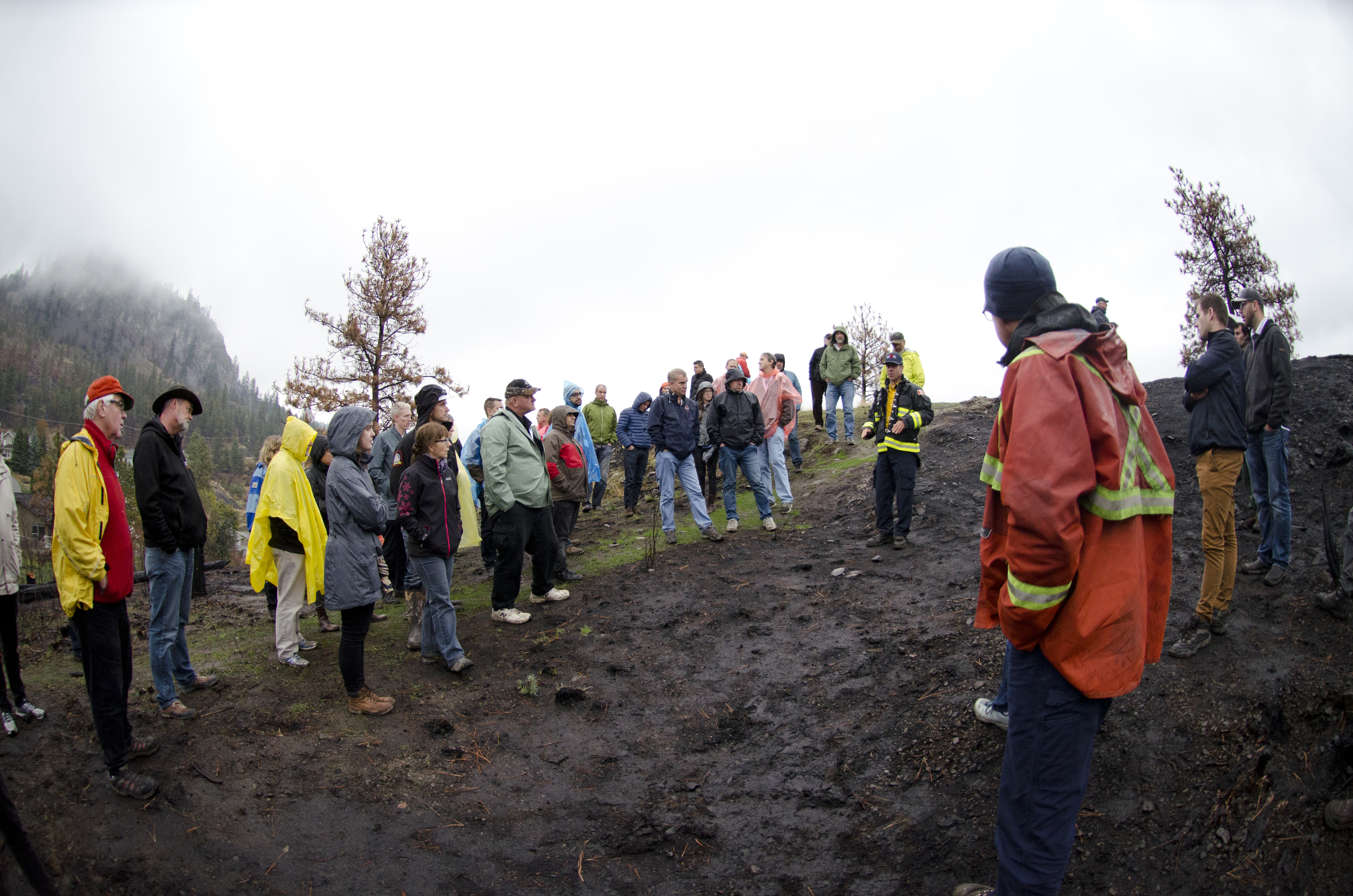
WFC2016 field trip. The wettest day of the whole month in normally-dry Kelowna, BC.
There was a small video component, where we managed to capture some sessions and publish them online for posterity; it was mainly for the plenary guest speakers, but also a few technical sessions. We had a couple of actual video cameras and I recall asking a student helper to run around with a tripod. It was just a bit early for everyone to be able to do this trivially with mobile phones.
Some 300+ people got to watch Cordy Tymstra, Mike Flannigan, and Al Westhaver present on the 2016 Horse River fire that occurred earlier that year. Francis Zwiers presented an important discussion on the statistics of event attribution, Carol Miller discussed fire ecology issues in wilderness areas (a talk that was interrupted by technical difficulties, and is actually smoother to watch on video than it was live), and some of the technical breakout sessions were captured as well. But so what? Why are these poorly-viewed videos being mentioned here when there are millions of other videos of YouTube and other platforms, including many on wildland fire topics?
Well, here’s my take as someone who’s attended about 15 wildfire conferences in the past 25 years. It’s awfully hard to remember what you saw, even a few weeks later! Videos, if they existed, would be a valuable resource to help attendees recall and get maximum value from the time and expense invested in a conference trip.
In my experience, the first day of a conference, typically, is full of energy, and everyone is dutifully attending all talks and taking notes, taking screenshots and asking questions. Even by that first afternoon, some folks have put away their notebooks and resort to simply watching, hoping to remember the key points for later recall. But a couple of days later, after the banquet, the entertainment session, a couple of excellent plenaries and maybe 5 or 6 (or 15) technical sessions, it’s all you can do to actually attend and not stay in your room or head to the bar with your friends. Late presenters definitely get the short end of the stick in terms of audience interest and energy.
Then there’s the issue of concurrent sessions – what do you do when there are two (or more) talks that you want to see simultaneously? Having 3 or 4 or more concurrent sessions is very common, so you can’t be everywhere. The most extreme example of ‘death by choice’ that I can recall was an AFE conference I attended some time ago with 10 concurrent sessions. (It was a fun conference, but I couldn’t help but think that any 2 people attending would probably have completely different experiences in terms of technical sessions. )
Even if you’ve taken great notes during some sessions, even a couple of months later it’s awfully hard to recall who gave which talk or showed that excellent graphic that made an impression that you’d love to revisit.
This is where the videos come in. It has never been easier to make or host high quality online content, allowing attendees to re-watch the sessions they found most profound. This way they might get to see the ones they missed because of conflicts or bad timing (“had to catch that early flight so I wouldn’t miss my daughter’s recital!”).
Why don’t all conferences retain video of the presentations? I can think of a few reasons – production costs, maintenance costs, permissions, etc.* It often just comes down to the work involved and lack of obvious demand for a service. But still – online tools are cheap and readily available, platforms such as YouTube are essentially free, and permissions can easily be sorted with some small print and a disclaimer. I remember an excellent IJWF conference in Marseille a few years ago where a small army of students were handling an excellent video team, ostensibly capturing every session on video (Christophe – where are these videos today??). At WFC2022, nearly all sessions were recorded. A link was provided with session videos available for later viewing for 6 months after the conference. That was better than nothing, though I’d love to go back and rewatch some of those videos today. But by 2025, the Wildfire Summit offered no recording capabilities.
Would it not be valuable to know that recordings exists from all conferences you attended? This makes sense if you were a paid attendee, right? Ah – but what if you weren’t there and didn’t pay? Should you get to see the content for free? We faced this question at WFC2016, ultimately deciding that videos would be viewable for paid attendees only for the first year and then free for all viewers thereafter. This, unfortunately, may have resulted in very low view counts! Well, you can’t win ’em all.
But still – shouldn’t all conference presentations be recorded for viewing as online videos? I suppose we could ask the same of other materials. Should all conferences have printed Proceedings (at least in pdf form; paper versions shipped for extra cost, ok?). In my view, the more media the better. If the work is important, you don’t just want to hear about it once at the conference, you want to be able to cite it and watch it all over again as needed. Some futurists tell us that scientific papers are obsolete; online data, tools, and technology are the future. A plethora of AI-based tools may be suggesting that future is here already. Personally, I’m not so certain for papers – there’s probably still a need for peer-reviewed formal descriptions of new ideas and understanding. But for the less formal work presented at conferences, and the ‘hard to publish’ stuff like software, databases, case studies, random fire media (who doesn’t love a great fire video clip?) and more speculative ideas, I’d certainly rather view a video (maybe with a nice pithy description phrase, in lieu of an abstract) than read a conference paper.
So this is my plea to conference organizers – let’s get volunteers at each venue (students are great) who can run video ops. They can be offered a discount, free banquet ticket, or free drink tickets, whatever, in exchange for setting up a phone for recording in each room where sessions are being held (100% coverage is less important than trying to get most talks covered). With a simple cloud storage account, everyone can upload their videos daily, and we end up with a permanent record for viewing in perpetuity.
Then we won’t have the 6-month hangover problem after each conference we attend, trying to recall if we were actually even there.
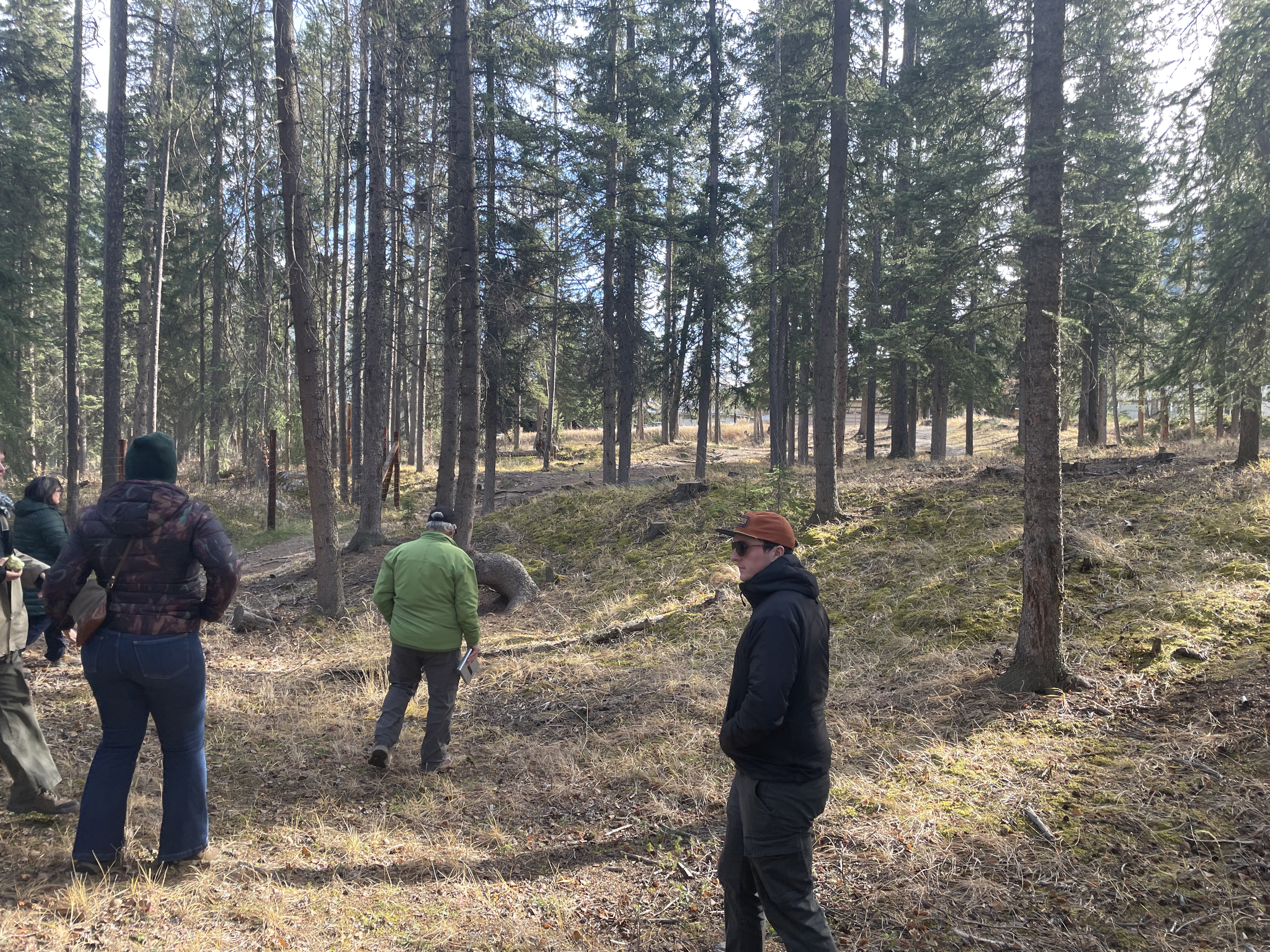
Enjoying the Wildfire Summit’s Banff field trip (Banff thinning project).
* Oh right – permissions. At WFC2016, we paid some money for well-known US author John McLean to come and give a keynote. He was working on another book, this time about the Yarnell Hill fire disaster in 2013. As part of his narrative, he named a witness and shared some photos this person took of the last minutes and hours of the Granite Mountain Hotshots. Well, a few months after our video went live, somehow this individual saw it (it only had 42 views at the time!) and filed a complaint with Vimeo (the platform we were using at the time). We had to take down the video and got threatened with litigation; we were mad, McLean was mad, the witness was mad, and the whole thing was a huge bummer. I guess sometimes permissions do need to be granted in writing. I still have the video, but sure won’t be posting it online anytime. Like I said before – you can’t win ’em all. Most videos can be shown with zero controversy, but sometimes you can get in trouble.
 FireResearch.ca